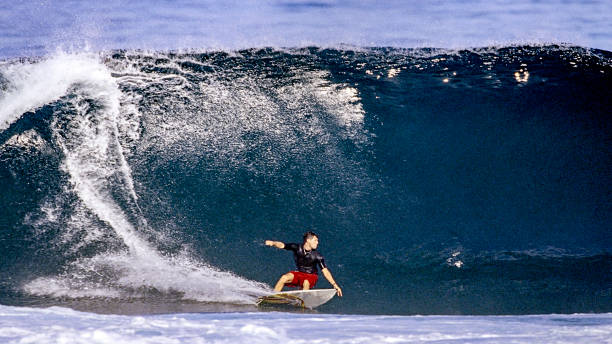
When you paddle into a slab and feel the ocean suck the water out from under your board, you know something special is happening. The horizon tilts, the reef turns into a blur of dark shapes, and then you’re dropping. That drop is the last normal thing you’ll feel for a few seconds. The lip throws over your head, and suddenly you’re in a different world. This is not just a wave. This is a liquid cave that’s moving at thirty miles per hour, and you’re inside it. Welcome to the barrel.
Now, here’s the part that catches most surfers off guard. Inside the tube, your senses go haywire. The roaring chaos outside becomes a hollow, muffled hum. Your eyes lock onto that tiny patch of daylight at the exit, known to old surfers as the keyhole. Everything else fades. Your peripheral vision narrows into a laser point. You don’t see the spray or the foam or the crowd. You just see the light. And in that moment, your entire life reduces to a simple question: are you going to make that light before the wave swallows you whole?
This altered state, this intense focus, is what surfers call tube vision. But it’s more than just seeing. It’s a full-body calculation. Your back foot feels the fins vibrate against the changing pressure of the water. Your front arm reaches up and touches the curtain of water above you, just to remind yourself where the ceiling is. Your knees compress and release like springs, keeping your board glued to the steepest part of the face. You’re not thinking anymore. You’re pure instinct, riding the thin line between being pitted and being pounded. It’s like your body becomes the wave and the wave becomes your body.
The craziest thing about the barrel is how time behaves inside it. What lasts two seconds on the surface can feel like an eternity in the tube. It’s more like your whole life gets condensed into a single, crystal-clear snapshot. You notice the texture of the water, the veins of foam curling over the lip, the way the light refracts through the green glass like a stained-glass window. You feel every vibration of your board, every micro-adjustment of your weight. It’s overwhelming and Zen at the same time.
Some people chase this feeling relentlessly. They’ll book flights to desolate reefs, sit in the lineup for hours, and eat massive wipeouts just to get one ride where they’re fully covered. And why? Because the tube offers something that no other part of surfing can. It’s a secret room inside the ocean, a place where the noise of the world goes quiet and only the pure essence of riding remains. When you’re shacked, you’re not just surfing a wave. You’re surfing the very heart of the ocean itself. The wave is breathing around you, and you’re part of its breath.
But there’s a dark side to tube vision. The deeper you go, the smaller that keyhole gets. The bigger the wave, the faster the lip. And there’s always the possibility that the exit will close out entirely. That’s when the barrel becomes a washing machine, and you’re the sock. You’ll get tossed, spun, and pounded into the reef. You’ll take a breath of aeration and pray that your board leash doesn’t snag. Yet even in those moments, there’s a strange clarity. The panic comes, but it’s surrounded by an eerie calm. You learn to relax in the chaos, because fighting the ocean only makes it hurt more.
In the end, tube vision is about trust. Trust in your instincts, trust in your equipment, and trust in the wave itself. The barrel is not your enemy. It’s a partner in a dance that has been happening since the first surfer discovered a hollow wave. Every time you enter that liquid cave, you’re adding your story to the long history of the tube. And when you fly out the other side, spat clean into the sun, you carry a piece of that blue-green world with you. You’ve seen the light. And now, nothing on dry land will ever feel quite as bright.