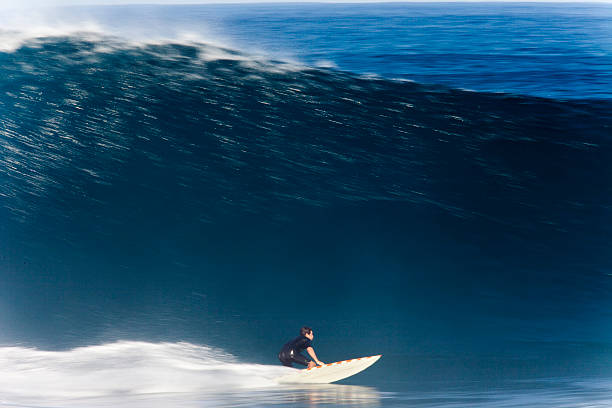
There’s something sacred about a point break. Not every wave is born equal, and anyone who’s spent enough salt in their veins knows that beach breaks are fickle, reef breaks are heavy and hungry, but a point break? That’s the wave that dreams are made of. It peels right or left with a clean, endless wall that seems to stretch all the way to tomorrow. You paddle out with a grin that doesn’t fade, because you know the ocean is about to gift you something special. A point break doesn’t throw you around like a washing machine; it offers a rhythm, a line, a story that unfolds section after section like a perfect verse.
So what makes a point break tick? It all comes down to the land and the swell. When a wave hits a rocky headland, a jutting cliff, or a sandbank that runs alongside the shore, the bottom contours bend and refract the energy. That bending forces the wave to break gradually, peeling along the edge instead of crashing all at once. The result is a long, peeling wall that offers rides that can last hundreds of yards. You get that glorious sensation of traveling, of moving down the line with the ocean pushing you from behind, the spray flying off your rail as you tuck into a deep carve. Unlike a beach break where the sand shifts with every storm and the peaks appear and vanish like whispers, a point break is consistent. It holds its shape swells after swell, season after season. That consistency is what builds legends, what turns locals into masters of every foamball and bump.
The feeling of surfing a point is hard to describe to someone who hasn’t felt it. You paddle into the lineup, drifting with the rip along the headland, and you watch the swell lines march in like a procession. When your wave comes – that single, beautiful pulse of energy – you paddle hard, feel the tail lift, and then you’re dropping down a face that’s impossibly smooth. The bottom turn sets you up, and suddenly you’re flying down a wall that just doesn’t quit. You can pump, you can carve, you can hunt for the barrel, and the whole time you’re not fighting the wave – you’re dancing with it. It’s a conversation. The wave speaks in speed and steepness, and you answer with your feet, your fins, your whole body. There’s a zen to it, a meditative flow that makes everything else fade away. Time doesn’t exist on a point break. Waves keep coming, rides keep connecting, and the sun starts moving across the sky without you even noticing.
The culture that springs up around point breaks is its own thing too. Because the spot is so reliable, the same crew shows up every day. There’s a respect that builds, a pecking order based on time in the water, not just talent. You learn to wait your turn, to read the lineup, to share the stoke. There’s a reason localism exists at famous points like Rincon or Malibu – when a wave is that good and that scarce, people guard it like treasure. But when you’re respectful and humble, the lineup opens up. You get those magical dawn patrols where the water is glassy, the offshore breeze is blowing gently, and the whole ocean feels like it’s breathing with you. Those are the moments that turn a surfer into a lifelong devotee.
Compared to beach breaks, which shift and morph with every sandbar, or reef breaks, which punish mistakes with a coral rake, point breaks sit in that sweet spot. They’re predictable without being tame. They can throw a legitimate barrel over a shallow reef at low tide, but they also offer an easier paddling channel and a longer ride than most other setups. That’s why they’re the favorite of longboarders and shortboarders alike. A point doesn’t care if you’re on a log or a fish – it just offers up its line, and you take what you can carve out of it. Some of the best days I’ve ever had were on a peel at a mellow point, riding one wave, kicking out, and paddling back out to do it all over again while the waves just keep zipping down the rocks like they’ve been doing it for millennia.
There’s an endless summer quality to point breaks, a spirit of chasing that perfect run. They remind us why we picked up a board in the first place – not for the adrenaline, though that’s part of it – but for the pure, unadulterated joy of riding a natural wave in its finest form. Whether it’s a tropical paradise with palm trees swaying or a cold-water slab with cliffs rising above, the point break holds a special place in the surfer’s heart. It’s the wave that keeps you coming back, that makes you check the swell forecast at dawn, that fills your dreams with endless walls and clean barrels. When you find a good point break, you guard it, you respect it, and you thank the ocean every single session. Because a point break isn’t just a surf spot – it’s a teacher, a friend, and a lifelong obsession.