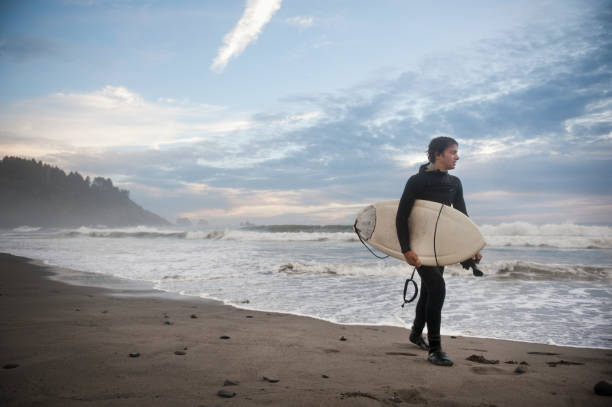
There’s a moment every surfer knows too well. You’re sitting in the lineup, the morning glass is doing its thing, and suddenly a little trickle of ice water snakes down your spine. That’s the wetsuit whisper reminding you that your rubber ain’t doing its job. Whether you’re paddling out in warm tropical mush or charging winter slabs in the North Atlantic, your wetsuit is the thin line between stoke and shiver. And here’s the thing: there is no one perfect suit. There’s only the perfect suit for the conditions you’re paddling into, for the kind of session you’ve got planned, and for the particular engine that is your own body.
When we talk about wetsuits for all conditions, we’re really talking about thickness, flexibility, and fit. Thickness is measured in millimeters, usually listed like 3/2, 4/3, or 5/4. The first number is the thickness over your core, the second over your limbs. That core number is everything because your torso is where all the heat hangout lives. A 3/2 is your spring and summer staple, perfect for water temps in the low sixties to low seventies. It gives you plenty of movement for those long point breaks and hot dog airs. But when the water drops below sixty, that 3/2 starts feeling like a fishnet. That’s when you step up to a 4/3, the workhorse of wetsuits. It handles the high forties to high fifties with confidence, especially when paired with booties and a proper hood. And for those true winter warriors, the 5/4 or even 5/4/3 is your nuclear option, built for water in the high thirties to mid forties. That suit is thick, heavy, and just plain gnarly, but it lets you keep frothing when everyone else is on the couch.
But thickness alone doesn’t save you. The real magic lives in the seams and the seals. A good wetsuit today uses glued and blind-stitched seams, taped on the inside to stop water from flushing through the needle holes. That’s your first line of defense against the dreaded flush, that icy wave that rushes in when you take a tumble or get caught inside. Even better are the fancy new liquid seam taping and welded seams that stretch with you and never let a drop sneak past. Every brand talks about their special “thermal lining” or “firewall” technology, and honestly, a lot of it is marketing fluff. What actually keeps you warm is a snug fit and solid seals around the neck, wrists, and ankles. If there’s even a little gap at your wrist, water pumps in with every paddle. That’s why a good wetsuit needs to hug you like a second skin, not loose and baggy, not so tight you can’t breathe. You want that tricky balance where it’s hard to put on but feels amazing once it’s on. And I can’t stress this enough: do not buy a suit based on your street clothes size. Try it on. Move your arms, squat, pretend you’re paddling for a bomb. If there’s bunching in the armpits or a ballooning at the small of your back, that suit is going to flush like a toilet.
Now let’s talk about flexibility because too many surfers sacrifice movement for warmth. A thick 5/4 can feel like a suit of armor if it’s made from stiff neoprene. But modern materials have come a long way. The good stuff uses super-stretch neoprene in the shoulders, arms, and chest, with a more compressed, less stretchy material in the torso for insulation. That’s how you get a winter suit that still lets you throw a ripping cutback or a full carve off the top. Look for terms like “max flex” or “superstretch” when you’re shopping. And pay attention to the back panel. A classic chest zip or back zip changes how the suit flexes. The newer chest-zip designs have fewer seams and sit lower on your neck, which means less water entry and way more mobility through your paddle stroke. Once you go chest zip, you’ll never want those old-school back zippers again. But they do take a bit of practice to get in and out of, so maybe practice at home before you’re shivering in a parking lot with the wind howling.
Here’s another underrated piece of the all-conditions puzzle: your booties, gloves, and hood. That’s where you lose most of your heat after your core, aside from your head. A good pair of 3mm or 5mm booties not only keeps your feet from going numb, they give you traction on rocky trails and sharp reef. Hoods are a game changer when it’s properly cold, but a lot of surfers hate the claustrophobic feel. Try a hooded wetsuit or a detachable hood for those arctic sessions. Gloves are essential in the truly frigid lineup, though they do mess with your grip on the board. The trick is to find gloves with pre-curved fingers that let you hold your rail without fighting the neoprene. And never skimp on the little things. A good wetsuit repair kit and a hanger that won’t stretch the shoulders are as important as the suit itself.
Finally, think about your own body. Are you a hot-blooded person who always runs warm? You might get away with a 3/2 in water that would freeze your buddy. Are you skinny and shiver easily? Then the 4/3 is your friend even in late spring. Your session intensity matters too. If you’re paddling hard, wiggling, and throwing aerials, you’ll generate heat. If you’re sitting still on a small day, you’ll need more rubber. The beauty is that modern wetsuits offer so many options for every condition, from the featherweight 2/2 for tropical summer dawn patrols to the 7mm beasts for polar expeditions. So do your research, get fitted right, and treat your suit with love. Rinse it fresh after every session, dry it in the shade, and it’ll have your back in every kind of lineup this planet can throw at you.