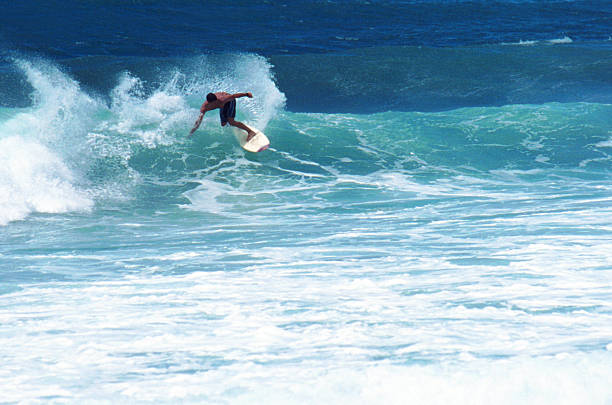
There is a moment on every good wave when the wall suddenly stands up like a liquid door, and your board seems to want to keep charging straight into the whitewash. But you don’t. Instead, you sink your back foot, let your front arm reach out like you’re about to shake hands with the horizon, and you pivot. The ocean bends around you, and for a split second you’re not riding the wave—you’re dancing with it. That, my friend, is the cutback in its purest form. Not just a maneuver to get back to the pocket, but a statement of intent, a way of saying that you came to this wave not to survive it, but to shape it.
Every cutback starts long before the turn itself. It starts with your bottom turn. If you’ve been charging down the line with speed, that bottom turn is your foundation. You’re looking up at the lip, reading where it’s going to pitch, and you’re carving off the bottom with a deliberate sink of your hips. The board feels like it’s gripping the water, and you can feel the fins digging in. That’s your moment to build potential energy. A cutback without a solid bottom turn is like trying to throw a punch without planting your feet—it just flails. So you commit to that turn at the bottom, let your body coil, and then you begin the climb.
Here’s where the style comes in. The cutback is not a snap. A snap is that explosive backhand reversal, a whip of the tail that throws spray like a firecracker. A cutback is smoother, more arcing, more patient. You’re not trying to smack the wave; you’re trying to wrap yourself around it. So as you approach the lip, resist the urge to slash. Instead, drive your board up and over the crest, letting your rails bite into the falling face. Your rear arm comes across your body like you’re hugging a beach ball, and your eyes lead the way—they should already be looking back down the line, past the foam ball, to the open face that’s waiting for you. The wave will tell you how tight to make that pivot. If it’s a steep, hollow pocket, you can really push off the lip and redirect your momentum with a sharp rail-to-rail transition. If it’s a softer, mushy wall, you might need to sink deeper, hold that carve longer, and let the fins release just a touch to slide into the turnaround.
The true magic of a cutback happens in the middle of the turn, when your board is perpendicular to the wave’s direction. That’s the pivot point. This is where most surfers chicken out. They get scared of losing speed, so they let the board straighten out, and the whole maneuver turns into a mediocre swoop. But no, you have to trust the physics. As you pivot, you’re actually transferring your speed into the turn. The board is rotating, your body is centered over the stringer, and you’re using the wave’s own force to slingshot you back into the pocket. It’s like throwing a yo-yo out and letting the string snap it back—except the wave is the string, and you’re the yo-yo.
Now, the style component. You’ve probably seen those purist longboarders who do a slow, drawn-out cutback that seems to take an eternity. They hang their front arm off the rail, drag a hand in the water, and let the board inscribe a perfect semicircle. Then you’ve got the shortboard rippers who do a vertical throw-and-return, with foam flying and fins releasing. Both are cutbacks, but the soul is the same. It’s about changing direction with confidence, with a bit of jazz. Style is just how you phrase your movement. Some guys like to add a little stall before the turn, letting the lip surge past them so they can carve into the whitewater. Others like to fade a bit at the top to wrap the turn around the curl. Find what feels good. The ocean doesn’t grade you on a rubric, but it does reward those who listen.
You also can’t forget the recovery. After you’ve pivoted and your board is now pointing back down the line, that’s when the cutback really comes alive. You should be moving with purpose, pumping your legs to regain speed, and resetting for the next section. A cutback that leaves you bogged in the flats is just a pretty way of stopping. A good cutback should feel like a breath—you exhale on the turn, then inhale as you race back into the pocket. The best surfers make it look like the wave is doing the work, but really they’re just channeling all that raw ocean energy through their feet, their knees, their hips, up into their shoulders, and out through their fingertips.
So next time you’re out there and you feel the wall start to close out, don’t just kick out and paddle back. Commit to that bottom turn, climb, pivot, and let the wave wrap around you. The cutback is not just a technique. It’s a conversation with the sea. And the more you practice it, the more fluent you become in the language of flow, the language of style, the language of endless summer.