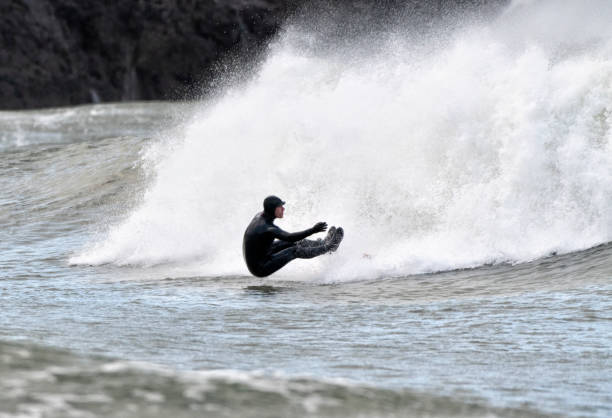
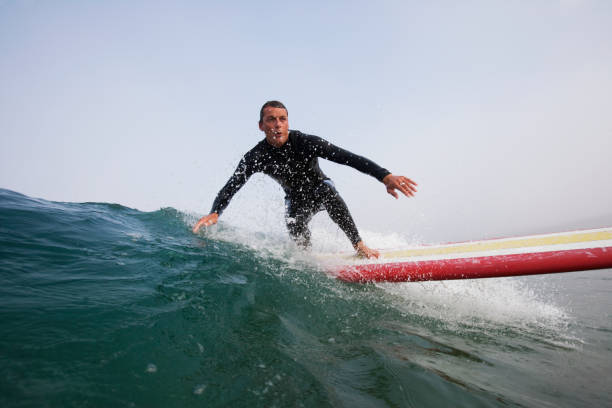
There’s a moment every surfer knows, that split second where the wave pitches and your board tips over the ledge. You’ve paddled hard, you’ve picked your line, and now the whole ocean is asking you one simple question: can you get to your feet without turning into a starfish? The pop-up is the most practiced and least understood move in surfing. Beginners think it’s about speed, ripping your knees to your chest as fast as possible. But the real magic is in staging the movement, slowing it down in your mind even as your body explodes upward. Think of it less like a jump and more like a slow unfurl, a flower opening against the face of a green wall.
When you watch a seasoned surfer on a clean point break, their pop-up looks like one fluid motion, a blur of knee, rail, and bottom turn. But if you break it down frame by frame, you’ll see three distinct phases: the plant, the pivot, and the press. Most people fail because they try to do all three at once. They slap both hands down on the board, yank their hips forward, and then desperately hop both feet toward the stringer. That’s not a pop-up, that’s a panic attack with a waxed deck. Instead, start with the plant. Your hands should land not next to your ribs like a push-up, but slightly lower, around your lower chest, fingers pointing outward. This gives you a wide base and keeps your weight centered. The back knee stays tucked, almost grazing the tail pad, while the front foot remains flat against the board, ready to wing upward. This is the moment where most surfers rush. They feel the wave moving and think they need to be standing yesterday. But remember, the wave is already moving you. You don’t need to hurry. You need to be smooth.
The pivot is where the magic happens. Instead of jumping both feet simultaneously, which sends your center of mass shooting straight up and then wobbling forward, you pivot your back knee across the deck. Imagine your back knee is a compass needle swinging from pointing at the tail to pointing at the nose. That knee drives across the board, dragging your back foot into position under your hip. Meanwhile, your front foot slides up to the stringer, not stomping, but gliding like you’re stepping onto a moving skateboard. Your hands are still on the board at this point, but they’re not pressing down with full weight. You’re using them like a tripod, just enough to keep the rail engaged. If you press too hard, you’ll stall the board and lose your speed. If you press too little, you’ll spin out and eat foam. The pivot is a dance between your hips and your hands, a subtle shift of weight from your chest down to your back foot.
The final phase is the press. This is where you finally leave your hands behind and rise to full stance. But don’t push with your feet like you’re doing a squat. Instead, press your hips forward, as if you’re trying to push the nose of the board away from you. This engages your glutes and keeps your back straight, preventing the classic “butt back, shoulders forward” hunch that kills your balance. Your knees stay bent, soft and springy like you’re riding a bike on a dirt path. Your front foot is turned slightly outward, about 45 degrees, and your back foot is perpendicular, heels down, toes curled over the rail. The press is not a jump, it’s a settle. You’re lowering your center of gravity into the wave, becoming one with the face before you take your first bottom turn.
Here’s where the timing comes in. The staged pop-up is slower than the frantic jump, but it’s actually more effective because it never breaks your connection to the water. When you do a hasty jump, you leave the board for a split second, and in that split second, the wave can toss you off balance. The staged approach keeps at least one point of contact with the board at all times, whether it’s your hands, your knee, or your front foot. That continuous contact means you’re always feeling the feedback from the wave, always adjusting your weight in real time. It’s like the difference between trying to mount a horse by leaping onto its back versus stepping into the stirrup and swinging over. Both get you there, but one is smoother and way less likely to end with you kissing sand.
Practice your pop-up on dry land first, but not on a hard floor. Use your surfboard on a patch of grass, or even a yoga mat. Run through the three phases slowly, almost like tai chi. Plant, pivot, press. Plant, pivot, press. Let your muscle memory build the sequence without the rush of a falling wave. Then, when you’re out in the lineup and you catch that uneven takeoff, your body will know the pattern. You won’t have to think about it. The stages will blur into a single, elegant motion that feels like you’re simply rising to meet the ocean. That’s the real goal, not a fast pop-up, but a graceful one. The wave doesn’t care how quick you stand. It cares how balanced you are when you finally do.