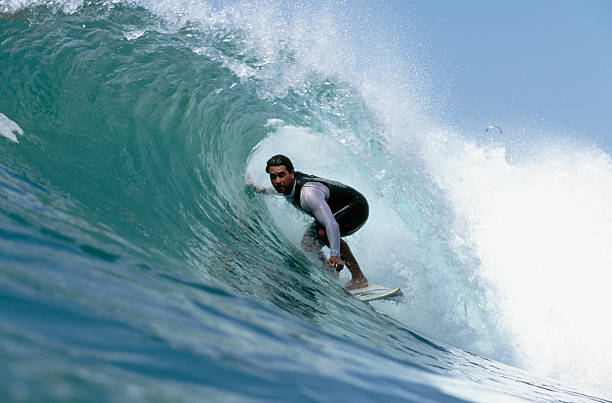
Catching an aerial is never just about the pop. You can have the baddest board under your feet, a wave with a lip so steep it looks like a cliff, and all the technique in the world, but if your head ain’t in the right place, you’ll end up eating foam faster than a beginner on a longboard. The truth is, aerials are as much a mind game as they are a physical feat. Forget the rotation, forget the grab, forget the stomp. The first thing you need to launch is the decision to actually go. That’s the whole ballgame right there.
When you’re dropping down the face of a solid set, your brain starts screaming all sorts of nonsense. It tells you to bail, to hit the brakes, to pull off the bottom turn and just fade back down the line. That voice is your survival instinct, and it’s a liar. It doesn’t know that the lip is ready to pitch, that your fins have enough traction to slingshot you skyward, that you’ve done this a hundred times in the foam and on the trampoline. The only way to shut that voice up is to make the decision before you even take off. You paddle for that wave with one thought only: I’m going air. No second-guessing. No “maybe if the wave tells me.” You commit before the drop, and then you let your body follow the plan.
That commitment is what separates the rippers from the dreamers. I’ve seen guys with crazy flexibility and cat-like reflexes who never get more than an inch off the water. Why? Because they hesitate. They hit the section, and in that split second, their brain clicks into “brake” mode. They shift their weight just slightly back, the board stalls, and the lip detonates right on their head. On the flip side, I’ve seen chunky guys with mid-level styles boost massive airs just because they throw themselves into the pit with total abandon. The wave doesn’t care how stylish you look when you’re sideways in the sky. It cares about whether you fully commit to the launch.
Visualization is your best friend out there. Before you paddle out, sit on the beach and watch the sets roll through. Pick a wedge, a bowl, a steep takeoff zone, and imagine the whole sequence in your head. See your bottom turn, driving through the foam ball, eyes locked on the lip. Feel your back foot pressing down, loading the tail like a spring. Then see the unweighting, the moment your front shoulder throws forward and your feet leave the deck. Hear the silence of just hanging there, the board still beneath you, the wave rumbling under your feet. Then feel the landing, absorbing the impact with bent knees, racing off down the line with a spray of foam. Do that fifteen times in your head, and the real thing starts to feel familiar. Your mind doesn’t know the difference between a vivid imagination and the actual event. It just builds the neural pathways and makes the physical action smoother.
Another key part of the mental game is understanding that you will eat it. A lot. Airs are high-risk, especially when you’re learning. You’re going to get pitched, you’re going to get twisted, you’re going to have your board smack you in the ribs, and you’re going to come up spitting saltwater more times than you can count. That’s not a failure. That’s tuition. The surfers who blow up and land huge airs are the ones who’ve stacked more wipeouts than most people have had hot dinners. They treat every slam as a free lesson. Did your back arm swing too wide? Did you look down at the water instead of at the landing zone? Did you throw your head too far back? Each bail gives you a piece of the puzzle. The trick is to not let the fear compound. You take the wipeout, shake it off, paddle back out with a grin, and try again. The moment you let a hard slam get in your head, the mental game is lost.
Timing is also a mental rhythm. You can’t force an air on a section that isn’t there. You have to feel the wave breathing beneath you. When you set up for a hit, you’re not rushing. You’re waiting, letting the lip stand up tall and just start to throw. Then you strike. That patience is a mental state too. A lot of guys pump too early, lose the speed, mow the lip, and never get vertical. Or they pump too late and get barreled. Finding that sweet spot is all about staying calm, reading the energy of the wave, and trusting your instincts. The more you surf, the more your brain automatically computes the trajectory. But when you’re stressed, that computation goes out the window. So breathe. Relax your grip on the rail. Let your body find the rhythm.
The other underrated mental piece is progression. Don’t try to do a full rotation on a ten-foot slab on your first go. Start with a little straight air, a little ollie off the lip foam, a bit of a boost on a mellow day. Get comfortable with leaving the water and coming back down. Then add a bit of a tweak, then a rotation, then a grab. Each step builds your confidence, which is the most valuable currency in the surf. Confidence is just memory of success. Every small air you land, every sketchy recovery, every close call that you ride out – that all gets stored in your mental rolodex. When you’re paddling back out for a big one, you flip through that rolodex and remind yourself: I’ve done this before. I can do it again.
And finally, remember to have fun with it. The second surfing stops being fun, your brain tightens up, and the airs disappear. Laugh when you eat it. Cheer when your buddy lands one. The water is a playground, and the air above the wave is the ultimate jungle gym. So look up, commit, and let your mind fly before your body does. Because once that mental block crumbles, the sky’s the limit.