Let’s cut straight to the chase. In surfing, everything hinges on the pop-up. That single, fluid motion from lying prone to standing tall is the gateway to every turn, cutback, and barrel that follows. Mess this up, and you’re just a passenger on the wave. Nail it, and you’re in the driver’s seat, ready to carve your own line. This isn’t about fancy tricks; it’s about foundational power. It’s the difference between a kook struggling in the whitewater and a surfer setting a line for the shoulder.
Think of it as the most critical take-off in surfing. You’re not just standing up; you’re launching into a dynamic, moving environment. The mechanics are simple, but executing them under pressure—with the lip pitching behind you and the reef or sand below—is where the art lies. It starts on dry land. Practice on your living room floor until the motion is muscle memory. Position your hands flat on the board, directly under your chest. Your back is arched, head up, eyes forward—you’re a coiled spring, not a limp noodle.
When the wave lifts you, it’s go-time. This isn’t a slow, thoughtful push-up. It’s an explosive, single-action snap. In one motion, you push your upper body up while simultaneously swinging your back foot underneath you, planting it flat on the deck. Don’t place it too far forward or back; aim for the center of the board, perpendicular to the stringer. This is your anchor. Your front foot then follows in a smooth arc, landing somewhere between your hands, which are now coming off the deck. The key? Your back foot hits first. Always. This stabilizes the board instantly. A common kook move is bringing both feet up at once or leading with the front foot, which sends the nose diving or has you wobbling like a newborn giraffe.
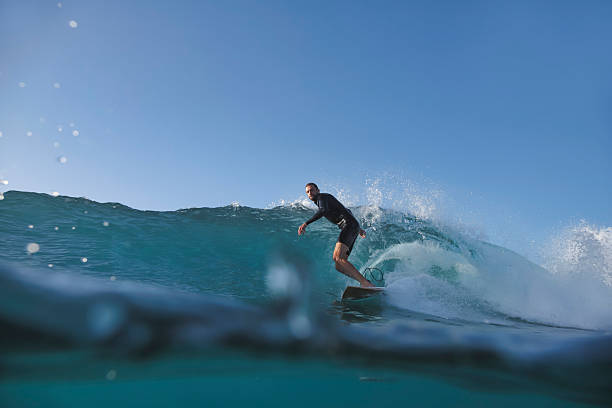
Your stance is everything once you’re up. You want a low center of gravity, knees bent, back straight. Your feet should be roughly shoulder-width apart, angled slightly across the board—this is your natural surfing stance, regular or goofy. Your arms aren’t for balance; they’re for steering and flow. Point where you want to go. Look down the line, not at your feet. Your body will follow your gaze. This initial stance sets your rail and dictates your first bottom turn. Get it wrong, and you’ll either pearl straight into the drink or slide out the back because you’re too stiff.
The pop-up’s perfection is judged by its efficiency and adaptability. On a fat, mushy day, you might have time for a slightly more drawn-out, casual stand. But when it’s pumping overhead and hollow, your pop-up needs to be a lightning-fast, committed thrust. There’s no second-guessing. You explode up and immediately engage your rail, projecting your weight forward to match the speed of the wave. It’s this connection between the pop-up and the first turn that separates the weekend warrior from the true surfer.
So, forget the advanced maneuvers for a minute. Go back to the basics. Drill that pop-up on the beach until it’s second nature. Because out in the lineup, when that set wave you’ve been waiting for finally swings your way, you won’t have time to think. You’ll just react. And a perfect, no-nonsense pop-up is the only thing that gets you out of the turbulence and onto the open face, ready to chase down that endless summer feeling, one flawless take-off at a time.